

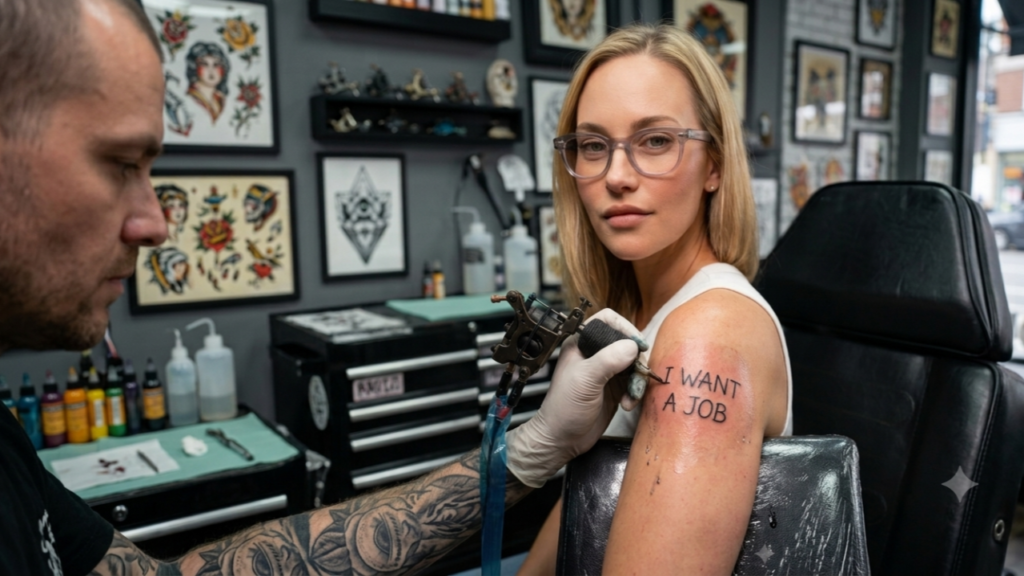
Last week, a five-person AI startup in San Francisco brought a tattoo artist to their Y Combinator afterparty and offered a job interview to anyone willing to get inked on the spot.
Seven people said yes!
The founder posted about it on LinkedIn, something about wanting to find people “as crazy as we are”. Deleted it within a day, and replaced it with one of the more thorough public apologies I’ve read in a while. He called it reckless. He acknowledged the power dynamic. He offered to cover tattoo removal costs.
The internet did what the internet does, and look, fair enough. It was a genuinely terrible idea.
But here’s my unpopular opinion: the tattoo is the least interesting part of this story.
The interesting part is that seven people said yes!!
Think about what that tells you: the offer on the table wasn’t a job; it wasn’t even a second interview. It was a first conversation – the thing that used to cost a candidate nothing more than a polished CV and twenty minutes.
And seven people looked at that offer and decided permanent ink was a fair price.
That’s not a story about one founder’s judgement. That’s a story about a job market where candidates are firing applications into automated screening systems and hearing nothing back, where getting to an actual human feels like winning a raffle. When access to a conversation becomes that scarce, people will pay strange prices for it.
One reaction to the story put it better than I could: the job market cannot be this cooked that people have to get tattoos to get interviews.
The uncomfortable bit
It would be very easy for those of us in NZ recruitment to watch this from a safe distance and say Tut Tut Silicon Valley, eh. What a circus.
Except we run quieter versions of the same bargain all the time.
The unpaid “test project” that takes a candidate a full weekend, for a role they may never hear back about. The five-round interview process for a mid-level position. The panel interview that’s really a stress test. The “quick coffee” that turns into a strategy session where the candidate solves your actual business problem for free.
None of these leave a permanent mark on anyone’s skin. But they’re built on the same maths: we hold the interview, you want it, so you’ll absorb whatever cost we attach to it.
The tattoo stunt just made that bargain visible. That’s why it went viral, not because it was unrecognisable, but because it was recognisable, taken one absurd step further.
The gut check I’m stealing
A former tech CEO responded to the saga with a simple test I think every hiring manager should laminate: would this still feel fair if the candidate walked away with nothing?
That’s it, that’s the whole framework.
The candidate who spends a weekend on your take-home task and doesn’t get the role- was that fair? The candidate who sits through five rounds and loses to an internal hire who was always going to get it – fair? The candidate who got the tattoo and not the job?
If the answer makes you wince, the process needs work. Not because you’re a villain; most of the employers I work with genuinely want candidates to have a good experience. It’s because hiring processes grow rounds and hurdles the way sheds grow clutter. Nobody decides to build an unreasonable process.
It accumulates over time.
And a word on the apology
Credit where it’s due: the founder’s apology was better than most corporate apologies I’ve seen from companies a hundred times the size. No “sorry if anyone was offended.” He named what he got wrong, acknowledged the power imbalance, and offered to fund removals.
Your employer brand isn’t just built by what you do. It’s built by what you do after you get it wrong. Most companies never get that second part right, which is why the ones that do stand out.
So no, I’m not going to pile on a 20-something founder who’s already apologised properly. I’d rather we all take the free lesson.
Before your next hiring process goes live, ask the question his company didn’t: if this went viral tomorrow, would we be proud of it?
And if the answer is “well, it wouldn’t go viral, it’s just a standard process” – that might be worth a second look too.
Some of the worst candidate experiences never trend.
They just quietly cost you the best people.
What’s the most unreasonable thing a hiring process has ever asked of you, or that you’ve caught your own process asking of someone else?
First published in Sarah’s LinkedIn newsletter, Recruitment Rambles. Read the original edition on LinkedIn.