
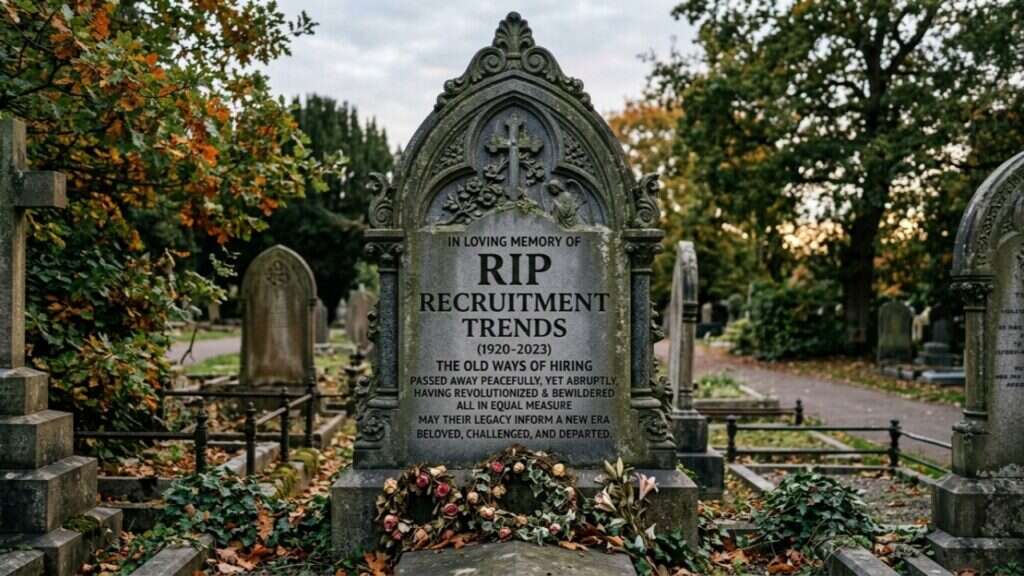
Every industry has its fashion cycle. Ours just moves faster than most, because unlike runway trends, recruitment trends are a direct read on how scared or comfortable employers currently are. So consider this the obituary page. Cause of death, surviving relatives, and what they actually taught us while they were alive, because none of these went quietly, and none of them died for the reason you’d assume.
The Entry-Level Signing Bonus
b. 2021 – d. quietly, sometime in 2023, no announcement made
Survived by: a handful of confused new grads still asking recruiters “wait, don’t you guys do that anymore?”
Cause of death: the labour shortage that created it recovered. The signing bonus was never generosity, it was panic, denominated in dollars. Employers were bidding against a candidate pool so thin they’d have paid in doubloons if asked. The moment the market loosened, the bonuses evaporated without a press release. Nobody admitted “we’re no longer desperate.” The cheques just stopped.
What it taught us: if you want to know how tight a labour market actually is, skip the unemployment stats and check whether junior roles are still throwing bonuses at people. Right now, mostly, they’re not. Draw your own conclusions.
Unlimited PTO
b. mid-2010s (US import) – d. by reputation, mid-2020s
Survived by: the phrase “flexible leave policy,” which is doing a lot of quiet rebranding work.
Cause of death: candidates worked out what it actually was. On paper, generosity, take what you need, no cap. In practice, no accrued leave liability sitting on the balance sheet, and, per the pattern widely observed in HR circles, people tend to take less time off under “unlimited” policies than fixed ones, because there’s no number to point to and no payout waiting if they leave. Hard to argue for a week off when there’s nothing to argue with.
What it taught us: the trend that sounds the most generous is the one most worth reading twice.
The Four-Day Week Pilot
b. 2018, Auckland, of all places – d. never, technically, but very much stalled
Survived by: a genuinely excellent piece of NZ business history that everyone cites and almost nobody replicates.
Cause of death: this is the one that shouldn’t be in the obituary column at all. Perpetual Guardian ran the original trial right here, eight weeks, roughly 230 staff, full pay retained and the results were strong: productivity up, stress down, work-life balance up enough that the company made it permanent and the story went global. It should have been the trend that stuck everywhere.
It didn’t, mostly, because the pitch is easy and the operations are hard. “Flexible working” costs a company nothing to promise in a job ad. A genuine four-day week requires restructuring how work actually gets done, which is a much less glamorous sell than the headline suggests. This one didn’t die of bad results. It died of being genuinely difficult to implement, which is a far less interesting story than the one everyone tells about it.
“Culture Fit”
b. unknown, probably always existed – d. publicly, cancelled sometime around 2019–2020
Survived by: “culture add” its own child, wearing a slightly better outfit to the funeral.
Cause of death: publicly executed once everyone realised “culture fit” was doing a lot of quiet work for “reminds me of me.” Fair cop. It was vague enough to let bias operate with plausible deniability.
Except, and this is the part worth sitting with, it didn’t actually die. It got rebranded. “Culture add” sounds like the enlightened fix, but in a lot of interview rooms it’s functioning almost identically: a soft, unstructured judgment about whether someone will “mesh,” now dressed in more defensible language. What died was the phrase. The instinct underneath it is still very much walking around, which tells you it’s a lot easier to kill a buzzword than a bias.
The “Fun, Fast-Paced Environment” Job Ad
b. always – d. not exactly dead, just increasingly ignored
Survived by: candidates who now read job ads the way lawyers read contracts.
Cause of death: not employers giving it up, candidates learning to translate it. “Fast-paced” reliably reads as understaffed. “Wear many hats” reads as no defined role and no cover when someone’s on leave. “Fun environment” reads as no budget for an actual one. The phrases haven’t disappeared from job boards. They’ve disappeared from ads that actually work, because enough candidates got fluent in the genre to skip straight past anything still using them.
What the obituary column actually tells you
None of these died because someone ran the numbers and decided they didn’t work. They died because the conditions that made them necessary, fashionable, or convincing changed underneath them and in one case, the trend didn’t die at all, it just changed its name and kept doing the same thing.
Recruitment trends aren’t really about the perk, the policy, or the phrase. They’re a live readout of who currently holds the power in the hiring relationship. Want to know what’s actually happening in the labour market right now? Don’t read the commentary. Read what’s trendy in job ads this month. It’ll tell you more than any headline stat will.
What trend do you think is next for the obituary page? I’ve got nominations, but I want yours first.
Sarah 🧡
First published in Sarah’s LinkedIn newsletter, Recruitment Rambles. Read the original edition on LinkedIn.